
Question:
I will be a Ph.D. student at the Technical University of Berlin this year. I turn 30 on October 22, and I was wondering whether the student health insurance for €27.50 a month would give me the necessary certificate to enroll? Thanks for your help.
Answer:
Doctoral candidates with an employment contract are insured through their job. Enrolled PhD students under 30 can often use the public student rate. Scholarship holders and guest researchers without either usually need a private plan.
As Ph.D. Student from abroad, we would like to recommend the private insurance plan “Care College”:
Care College plan and prices
Price: from €27.50 / month (Basic, up to age 29, first 24 months)
Long Duration: up to max. 5 years
Under the insurance tariff “Care College”, there are three different sub-tariffs: Basic, Comfort, or Premium. We recommend considering at least the College Comfort health insurance tariff (Price: only €34.00 per month, up to age 29 in the first 24 months).
To name a few of the strong points of the College Comfort insurance:
- No deductible
- A refund of two monthly premiums (see the plan terms for the conditions)
- Better treatment, up to 2.3 times the rate of the scale of fees

Our recommendation for international Ph.D. students in Germany:
If glasses or dental work matter to you, compare the Premium tariff (from €48.00 / month, up to age 29, first 24 months), which has the most extras: glasses allowance €100 after 3 months, dentures 70 % up to €1,000 after 8 months (Care College plan details).
Click here for all Details and Prices of the Health Insurance for international Ph.D. students:
Care College plan and prices
Master Student Degree and Postgraduate Program in Germany and Europe.
General Information
A Master’s Degree generally takes 2 or 3 years to complete.
Master’s students must complete preparatory coursework and undertake comprehensive examination and thesis project activities. Some master’s programs require a written thesis, and others offer an option between a thesis and a comprehensive exam.
An important way in which the master’s program differs from most doctoral/PhD programs is in the level of financial aid available to the students. Most programs do not offer as much aid to master’s degree students as doctoral students. Most public universities in Germany charge no tuition fees; check the semester fee.
Students from the postgraduate programs or second-degree programs in German universities are very successful in the international job market, especially in the technical and scientific areas.
Ph.D. Student Programs / Doctoral Degree in Germany and Europe
A doctoral degree (in German: Doktorand) is a more advanced degree than a Master’s degree.
In Germany, a student with Diploma from the university (Universität) can enter a doctoral program directly if the student meets the admission requirements. On the other hand, a Fachhochschule (FH) student with Diploma must have excellent grades to enter a doctorate program directly.
However, the Ph.D. researcher program takes time. Depending on the program, a candidate Ph.D. student needs up to 8 years to complete. Typically, a Dr. Ph.D. program entails 2-3 years of coursework and a dissertation, a research project designed to uncover new knowledge in the student’s field and be of publishable quality.
Most doctoral and Ph.D. programs offer various forms of financial aid like Erasmus scholarships, fellowship, or loans for international students. The availability and forms of aid vary by discipline and institution. Ph.D. Students in some programs earn master’s degrees “along the way.”
MORE DETAILS:
Ph.D. Student Health Insurance from €27.50 / month (Basic, up to age 29, first 24 months), more details here …
How much does insurance cost for a doctoral candidate?
Doctoral candidates without an employment contract pay from €34.00 a month on Care College Comfort (up to age 29, months 1 to 24) or €101.54 a month on Care Student if they are enrolled and exempt from public student insurance. The table shows the main routes side by side for 2026.
| Route | Per month | Over 12 months | Condition |
|---|---|---|---|
| Care College Comfort, up to 29, months 1–24 | €34.00 | €408.00 | No deductible; no enrolment needed; entry up to 40 |
| Care College Comfort, 30 and older, months 1–24 | €50.00 | €600.00 | No deductible; from month 25 €73.00 |
| Care Student, ages 12–29 | €101.54 | €1,218.48 | Health €69.62 + care €31.92; €300 deductible a year; health questions |
| Care Student, ages 30–39 | €127.60 | €1,531.20 | Health €95.68 + care €31.92; €300 deductible a year |
| Voluntary public insurance over 30 (minimum) | about €274 to €283 | about €3,290 to €3,400 | DAK and Barmer 2026 tables; entry conditions of the fund apply |
Source: the current tariff terms of Care College and Care Student (read 23.11.2026); DAK and Barmer contribution tables 2026 (read 23.11.2026). Care Student is issued by HanseMerkur Versicherungsgruppe (HanseMerkur Krankenversicherung AG); Care College by HanseMerkur Versicherungsgruppe (Advigon Versicherung AG).
Worked example: a doctoral candidate over 30 for 24 months
A scholarship holder aged 30 or older who starts Care College Comfort pays 24 × €50.00 = €1,200.00 over the first 24 months. The voluntary public minimum at DAK for a childless member is €282.13 a month, which is 24 × €282.13 = €6,771.12 over the same time, a gap of €5,571.12. The public route is open only if the fund's entry conditions are met, and the scope of benefits differs, so the comparison shows prices, not equal cover.
Who does a private plan fit for doctoral candidates, and who does it not fit?
A private plan fits doctoral candidates who are neither employed nor eligible for the public student rate. It does not fit employed candidates, enrolled candidates under 30 who join public student insurance, or doctorates that run past the plan's maximum term.
| Your situation | Fits? | Why and where to go |
|---|---|---|
| Employment contract with regular earnings above €603 a month | No | Employees are normally compulsory public members from the first working day (SGB V § 5 (1) no. 1 and § 186 (1)); see is health insurance mandatory. |
| Enrolled, under 30 | Usually no | The public student rate runs normally until the 30th birthday (SGB V § 5 (1) no. 9); an exemption leads to Care Student instead. |
| Scholarship holder or guest researcher without enrolment, aged 12 to 40 | Yes | Care College: see the plan overview, the plan details and the online application. |
| Enrolled and exempt from public insurance, aged 12 to 39 | Yes | Care Student, up to 60 months, then a switch to HanseMerkur tariff KVS1 without a new health check. |
| Doctorate longer than five years | Partly | Care College ends at five years including extensions; Care Student runs up to 60 months and then continues in tariff KVS1. |
Which option fits which doctoral candidate?
Our pick for doctoral candidates without an employment contract and without enrolment: Care College Comfort, because it has no general deductible and costs only €6.50 more a month than Basic in the first 24 months up to age 29 (€34.00 vs €27.50).
- Choose Care College Basic if the lowest monthly price matters most and a deductible of €120 per insurance year is acceptable.
- Choose Care College Premium if the glasses allowance and the higher denture refund matter.
- Choose Care Student (€101.54 a month at ages 12 to 29) if the doctoral candidate is enrolled and has been exempted from public student insurance.
- Choose the public student rate if the candidate is enrolled, under 30 and not exempted.
What are the limits and exclusions for doctoral candidates?
Each route has limits: Care College takes insured persons up to age 40 at the start and runs for 5 years at most, and Basic carries a €120 deductible per insurance year.
- Care Student has an age limit of 39 at entry, a deductible of €300 per calendar year and health questions covering the last 3 years.
- Employed doctoral candidates are usually insured through their job.
- An exemption from public student insurance cannot be revoked for the duration of the studies.
What happens after a doctoral candidate applies?
The candidate chooses the level, the start date and the term in the online application, pays online and receives the confirmation and insurance documents by e-mail; the cover starts on the chosen start date.
If the doctoral candidate later takes an employment contract or enrols and becomes subject to compulsory insurance, the plan terms allow ending the contract early.
Which sources and rules does this page rely on?
Employees and students are covered by different rules in the Fifth Book of the Social Code (SGB V), and the fund or the university decides on your case. Both rules matter before you choose a plan.
Sources: SGB V § 5 (1) nos. 1 and 9 (text of the law) and § 186 (1) (text of the law) (read 23.11.2026); SGB V § 240 (4) (text of the law): minimum assessment base for voluntary members, €1,318.33 a month in 2026 (computed from the Bezugsgröße, read 23.11.2026); the current tariff terms of the plans (read 23.11.2026).
Other Interesting Topics for You:
Our Customer Testimonials

I am a long-term visitor in Germany and needed quickly a cheap insurance.
Got my insurance docs within minutes. Best Value for the money.THANKS!

We have received the documents REALLY within minutes and were able to extend our visa.
Great service. Can only recommend it.
Will use it definitely also in future.

Excellent experience. I have nothing but good things to say about this website and the online application service.
Their pricing is fair and reasonable.

Best Value for the money.
Got everything on time and did use the documents without problem to obtain a visa in the German embassy.We love you guys and are very appreciative of everything you do!
This might also interest you
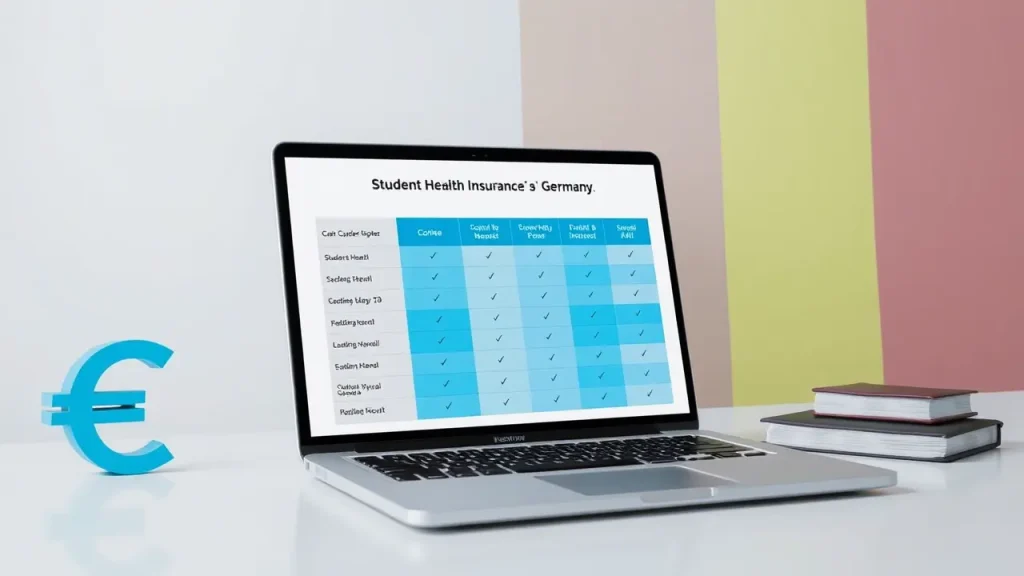
Student Health Insurance in Germany: Cost and Comparison

Private Health Insurance for Foreign Students in Germany over 30 years

Visa, Residence Permit, and Health Insurance for Job seekers in Germany from Countries Outside the EU
Medical Health Insurance for Foreign Students in Germany and Austria – from €27.50 a month (Basic, up to age 29, first 24 months; up to 5 years)

Public Health Insurance for Students in Germany Comparison, Changing and Cheapest Insurance Premiums
Frequently asked questions
I turn 30 soon. Does my student insurance end?
The public student rate normally ends at the 30th birthday, with exceptions for recognised reasons. After that you are a voluntary public member (at least about €274 to 283 per month in 2026) or choose a private plan. See the over-30 options.
I have an employment contract at the university. Do I need this plan?
Doctoral candidates with an employment contract are insured through their job. Care College is meant for doctoral candidates without that cover, such as scholarship holders and guest researchers.
What do Comfort and Premium cost after age 30?
At age 30 or older, months 1 to 24 cost €50.00 (Comfort) and €75.00 (Premium) per month. From month 25 they cost €73.00 and €99.00. Up to age 29 the prices are €34.00 and €48.00 in months 1 to 24.
I am a scholarship holder. Can I take Care College?
Yes. Scholarship holders are on the list of eligible groups, together with postgraduate and doctoral students. The plan starts at €27.50 per month (Basic, up to age 29, first 24 months). Check the plan terms for the conditions of each level. See the plan and tariff table.
My doctorate may take longer than five years. What then?
Care College has a maximum term of five years including extensions. The minimum term is one month. Plan the end date of your cover against your project schedule, and check the options with the plan provider if your doctorate runs longer. The monthly price rises from month 25, so compare the tariff table.
Can I cancel the plan early if my situation changes?
Premature termination needs written notice (e-mail, fax or post). The plan terms list cases such as the prerequisites for the policy ending or you becoming subject to compulsory insurance. The plan terms, shown before you pay, explain whether and how premiums are refunded.